


Hilti Manufacturing India?s Vadodara Plant Awarded DGNB Gold Certification ? A First for India
● The certification is a
powerful endorsement of Hilti’s commitment to holistic sustainability,
reflecting a balance of economic performance, ecological responsibility, and
sociocultural impact in every aspect of the plant’s design and operation.
● The plant features a
highly efficient HVAC system, passive cooling techniques, and a smart building
management system that helps monitor and optimise energy use throughout the
day.
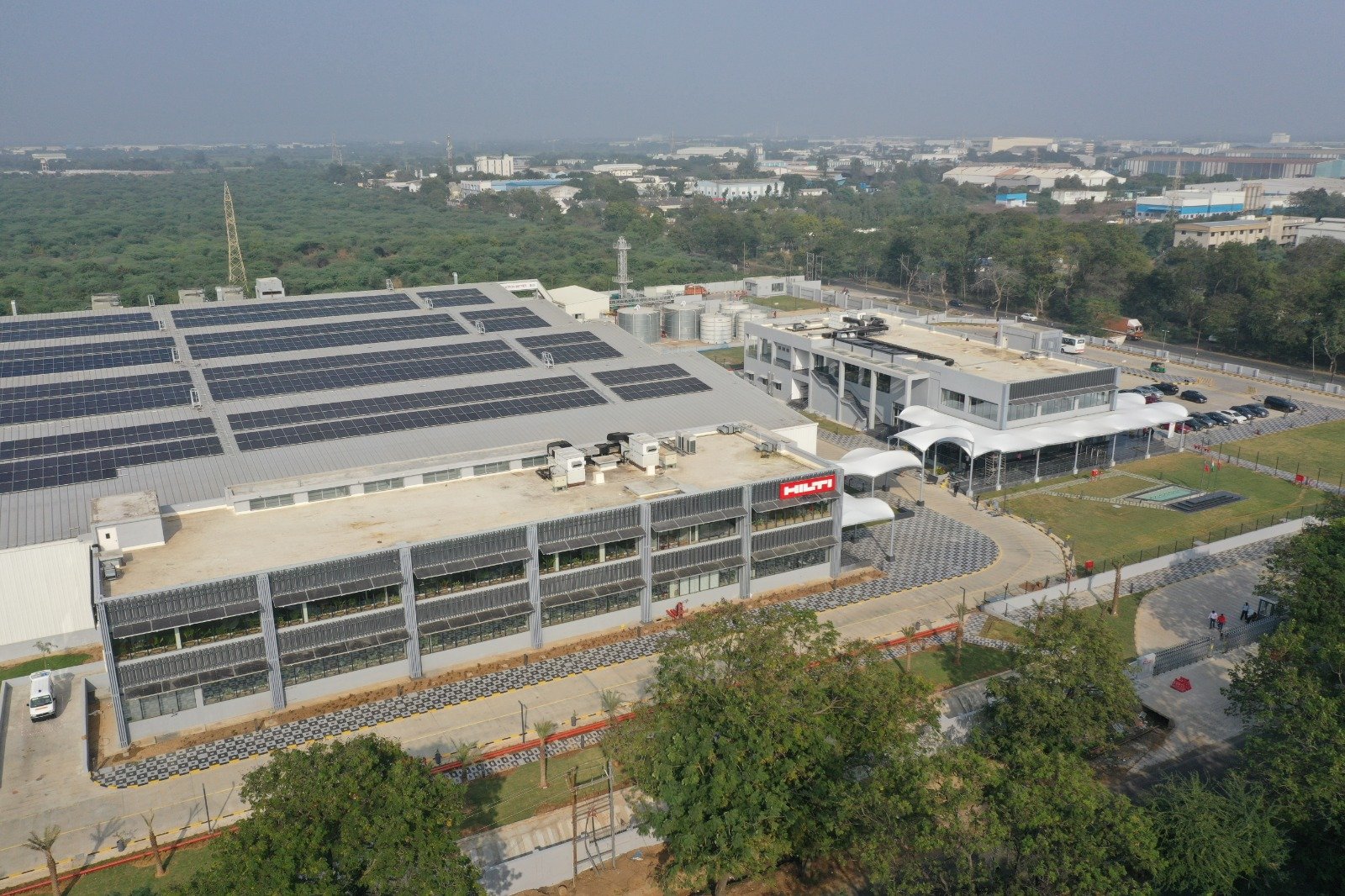
Hilti Manufacturing India’s
plant in Vadodara, Gujarat, has become the first industrial facility in the
country to receive the prestigious DGNB Gold Certification from the German
Sustainable Building Council. This milestone highlights Hilti’s long-term
commitment to building sustainable and future-ready infrastructure in India. It
also reflects the company’s global customer promise to be the best partner for
productivity, safety and sustainability. The certification reinforces Hilti’s
determination to bring that promise into tangible action on the ground, while
highlighting its efforts to decarbonise operations and achieve net-zero
emissions by 2050.
DGNB certification is one
of the world’s most rigorous and holistic benchmarks for sustainable building.
Developed by the independent nonprofit “Deutsche Gesellschaft für Nachhaltiges
Bauen,” the certification evaluates buildings across their entire life cycle –
from early planning and construction to operation and eventual decommissioning.
It assesses environmental performance, economic viability, user comfort, and
design quality, among other factors.
Giridhar
Jambunathan, Director & Chief Executive Officer, Hilti Manufacturing India,
commented,
“Industrial buildings present unique challenges when it comes to
sustainability, given their scale, complexity, and operational demands. From
the outset, our goal with the Vadodara plant was to go beyond compliance and
set a new benchmark for industrial construction in India. DGNB’s framework
provided us the right balance of environmental, economic, and social metrics to
guide that ambition. The Gold certification is a recognition of our team’s deep
commitment to designing a facility that reflects both performance and purpose.”
Johannes
Kreißig, Managing Director of the DGNB, said, “With the successful
completion of DGNB certification in India and Hungary, Hilti has demonstrated
that they set high standards for holistic sustainable construction in building
its own facilities worldwide. Hilti is playing a truly pioneering role here, as
the project in India is the first ever to be awarded DGNB certification in that
country. In addition, the project in Hungary achieved the highest possible
rating, with a DGNB Platinum certificate. This is a great result, and we can
only congratulate them.”
Hilti India’s Vadodara
plant sets a new standard for sustainable industrial construction in India. The
facility was designed and executed according to DGNB’s three central pillars:
economy, ecology, and sociocultural impact. A flexible layout maximises
adaptability for future expansions, and the site integrates advanced technical
systems to support high energy efficiency and optimal workplace conditions.
To meet economic efficiency
standards, the plant features a highly innovative HVAC system based on chilled
beams and radiant floor cooling. The system uses chilled water as its primary
cooling medium and operates in convection mode, maintaining comfort conditions
at 28±2°C. This water-based solution is approximately five times more efficient
than conventional cooling methods. To further reduce energy consumption, the building
incorporates multiple passive design features, including external shading
devices, overdeck insulation, and solar-protective façade fins. All systems are
connected to a centralised building management platform for continuous
performance monitoring.
The facility’s ecological
features reinforce Hilti’s environmental commitments. A 1500 MWh photovoltaic
system generates renewable energy, supporting operations and electric vehicle
infrastructure. The site is designed as a zero-discharge campus, equipped with
rainwater harvesting and water treatment systems that ensure 100% water
recycling. A Miyawaki forest, covering 25 per cent of the plant area, enhances
biodiversity using native species. Additional efforts to reduce light pollution
further contribute to the site’s ecological balance.
Hilti India also
prioritised human well-being and inclusivity in accordance with DGNB’s
sociocultural criteria. Following a “Design for All” philosophy, the building
includes ramps, elevators, accessible restrooms and workspaces, and a 1:1
gender-based design approach. More than 170 volatile organic compounds (VOCs)
were tested prior to occupancy to ensure safe indoor air quality. Acoustic
comfort and healthy materials were integrated into the office and production
areas. The facility also includes on-site amenities such as childcare, fitness
and yoga zones, jogging tracks, and common areas for employees and transport
staff.
Hilti’s journey in
sustainable building design began in 2010, when its plant in Austria received
the company’s first DGNB Gold certification. Since then, sustainability has
become a core consideration in every new facility Hilti builds. The Vadodara
plant joins the ranks of other DGNB-certified Hilti facilities in Austria and Hungary, with the company continuing
to embed environmental and social performance standards into all future
developments.

Current Issue
10-2026
