


The need of the hour for the future of Indian infra.

Geosynthetics is mainly a polymeric product. The polymeric nature makes them appropriate for use in a place where a high level of durability is required.
The function of geosynthetics are:
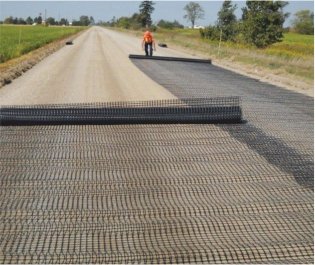
• Re-enforcement: Geosynthetics like non-woven geotextile and geogrid, improve the overall strength of the soil. They also prevent the lateral spreading of the base, increase the confinement and improve the vertical stress distribution of the sub-grade. The combined benefits can enhance the load-carrying capacity of the road and railway tracks by well over 50 percent.
• Separation: Non-woven geotextile helps in keeping the two layers of soil namely subgrade and aggregate, apart; thus preventing mixing and in turn deterioration of their function in the structure. This also prevents contamination of the soil and helps each layer distinctly perform its function.
• Drainage: Non-woven geotextile has very high permeability and allows water to flow freely along its plane into the side ditches. This function allows adequate liquid flow without soil loss.
• Filtration: The use of geosynthetics allows adequate liquid flow across the plane of the geotextile. The apparent opening size (AOS) allows water to pass freely from the geotextile while preventing soil to pass through the same. This is due to the skillful manufacturing of the non-woven geotextile's AOS, which is always kept less than the size of the finer soil particles.
The infrastructures need to have long term durability to prevent environmental disaster and land scarcity. Geosynthetics provide such solutions.
The importance of geosynthetics for the future of Indian infrastructure.
Geosynthetics is an integral part of a civil engineering project and is one of the innovations in the field of civil engineering by solving their problems. The need for Geosynthetics in the infrastructure sector is increasing continuously. As the burden on natural resources and the dire need for world-class infrastructure increases.
The use of geosynthetics in India is crucial. Geosynthetics can replace or minimize the use of scarce and expensive earthen material such as stones.
The significant role of geosynthetics in future
The land has become very expensive in India and geosynthetics can help with that by enabling the build of leaner, yet safe structures that are long-lasting. Geosynthetics significantly reduce capital and maintenance costs, speed up construction time, and are environmentally-friendly (sometimes even providing a green look). Projects involving geosynthetics can be completed with substantially less concrete and steel, and less earth, using reinforced soil walls on highways which reduce transportation and the carbon footprint. To achieve the aggressive infrastructure budget and timelines over the next few years, geosynthetics will play a significant role.

Geosynthetics: Need of the hour
For quality and for the long-term sustainability of the infrastructure modern materials are the need of the hour. Geosynthetics is one such material family with proven history worldwide. Be it road, railway, or any other civil or engineering discipline.
India is growing and the aspiration of the people of India can be addressed only when we have world-class infrastructure. Even to attract global players for the success of 'Make in India,' geosynthetics is an absolute must. Hence the role of geosynthetics cannot be argued about. It is a need.
Geosynthetics improve the quality and prolong the life of infra.
Awareness of modern-day techniques like geosynthetics is required to improve the quality of the infrastructure and in turn, prolong its life. Geosynthetics are very important for the future of Indian infrastructure because of the benefits it provides.
Use of geosynthetics in multiple sectors
Typically, geosynthetics work well where the quality of soil is poor or needs stabilization. Since soil is weak in many regions across India geosynthetics can be used in a variety of sectors such as roads and highways, landfills, container yards and ports, airports, railways, and canals, and mining.
Emphasizing environmental applications
Hydro engineering sector like shore protection with the use of geo bags and tubes, water conservation by creating artificial lake and water bodies, transportation engineering sector like road, railway, tunnels, and mountain engineering like rockfall protection in the hilly areas should see more usage in days to come. Environmental applications need special emphasis and more regulatory push.”
Key sectors driving growth
The following are the main infrastructure segments that will drive the growth of geosynthetics:
• Ports: Indian ports handled 1.135 MT of traffic in 2017-18, Indian ports are rapidly increasing and non-woven geotextile or geogrids are widely used for soil stabilization, geotextile or geogrid are placed below the subgrade to improve the CBR and load-bearing capacity of the soil enabling it to handle high axle load.
• Roads: India has a road network of 5,603,293 km which is the second largest road network in the world. Geotextile or geogrid is widely used for re-enforcement, filtration, and separation.
• Tunnels: Non-woven geotextile and geomembrane are used in tunnel lining and provide excellent drainage of water into the side ditches.
• Railways: Geotextile along with geogrid is widely used under railway tracks to provide stabilization and re-enforcement.
Geosynthetics significantly reduce capital and maintenance costs, speed up construction time, and are environmentally-friendly.
To attract global players for the success of 'Make in India,' geosynthetics is an absolute must. Hence the role of Geosynthetics cannot be argued about. It is a requirement and a need.
Awareness of modern-day techniques like geosynthetics is required to improve the quality of the infrastructure and in turn, prolong its life

Current Issue

10-2026
