


Application of Geosynthetic Products in Road Construction

Geosynthetics are a diverse family of various types of polymer materials formed into extruded grids and nets, blown film sheets and membranes, as well as woven and nonwoven geotextile blankets. Geosynthetics have proven to be among the most versatile and cost-effective ground modification materials.
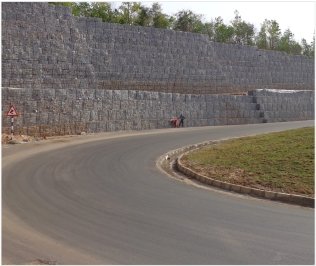
In road construction geosynthetics are used to strengthen base sections, improve the surfacing, and enhance drainage. The materials reinforce, separate, and stabilize subgrade and base materials providing the benefits of reducing aggregate requirements, simplifying construction, increasing roadway life, and reducing future maintenance. Geosynthetics also prevent accidents as they are able to withstand large lateral deformations and vertical differential settlements. Road structures can at times fail prematurely due to lateral displacement and weakening of base course aggregate. Geogrids or geotextiles are used to enhance performance or reduce the thickness of a permanent road, even when constructed on a reasonably competent foundation. They provide a tensile strength in the earth mass in locations where shear stress would be generated in road works. Moreover, they allow rapid dewatering of the roadbed and preserve their permeability without losing their separating functions.
The geosynthetic products most commonly used in roadway systems include geotextiles (woven and non-woven) and geogrids (biaxial and multiaxial), although erosion-control products, geocells, geonets (or geocomposite drainage products), geomembranes, GCL, and lightweight geofoams have also been incorporated in a number of applications. These various types of geosynthetics can be used to fulfill one or more specific functions in a variety of roadway applications.
Geotextiles
Geotextiles extend the service life of roads, increase their load-carrying capacity, and reduce rutting. Geotextiles perform three basic functions in stabilizing aggregate sections: separation, drainage, and reinforcement.
Geotextiles provide a separation layer between the aggregate and the subgrade soil, to prevent migration of fines and thus indefinitely preserve the original aggregate structural thickness.
Geotextiles provide this critical permeability as they filter or keep the fines from migrating upward into the aggregate. Maintaining drainage of the aggregate base and subgrade soil is very important to prevent accelerated failure of the support system. A geotextile also allows the use of more open, free-draining aggregates instead of those with fines, which are weakened by moisture and are freeze-thaw sensitive.
Geotextiles are used in reinforcement through mechanisms of restraint or confinement, friction, membrane effect, and local reinforcement.
Geotextiles also play a major role in the construction of paved roads over areas having a high groundwater table.

Geogrids
Geogrids enhances structural capacity & reduces potential distress. The primary function of geogrids used in pavements is reinforcement, in which the geogrid mechanically improves the engineering properties of the pavement system.
Geogrid reinforcement helps to improve the performance of the pavement by attributing three mechanisms (i) lateral confinement, (ii) improved bearing capacity, and (iii) tensioned membrane effect.
The geogrid apertures and base soil particles restrained aggregate lateral movement by transferring share load from the base layer to a tensile load in the geogrid. It increases shear strength & limits lateral strains in the base layer by using frictional and interlocking characteristics at the interface between the soil and the geogrid. The presence of a geogrid in the pavement imposes the development of an alternate failure surface that provides a higher bearing capacity and vertical confinement outside the loaded area. It is assumed that geogrid can act as a tensioned membrane. Using this tensioned membrane effect, geogrid contributes to supporting wheel loads & reduces vertical stress on the subgrade.
Geonets
The main application of geonets are (i) reinforcing existing, constructive new road surface, (ii) reinforcing joints of rigid pavement, patchwork, preventing cracking when the extending road, and so on. Geonet can also use for reinforcing soft clay subgrade.
While asphalt concrete surface reinforcement, Geonet fulfills two main objectives (i) Increases elastic properties of asphalt concrete at the same time increasing its resistance to elongation at long-term and multiply applied loads, (ii) Increase the distribution capacity of asphalt concrete, as a result of which the tense from a vehicle wheel is distributed to a larger area, resulting in less tense concentration and slowing down cracking processing.
Geomembranes
Geomembranes are relatively thin, flexible polymeric materials that are primarily used for the containment of liquid or vapor barrier or both. Geomembrane can be used to take care of the undulation problem due to the expansion of clay beneath the road surface. Due to an increase in the moisture content the clay tends to swell and causes a non-homogenous expansion and contraction. These cause a detrimental effect on the pavement. By using geomembrane, significant moisture changes in the pavement subgrade would minimize. It also provides several facilities such as strength properties, lighter weight, portability, cost-savings, and so on.

Geofoam
Geofoam is expanded polystyrene (EPS) or extruded polystyrene (XPS) manufactured into large lightweight blocks. The primary function of geofoam is to provide a lightweight void fill below a highway, bridge approach, embankment, or parking lot.
Construction of roadway embankments on soft foundation soils, such as peats or soft clays, has long been problematic. The two main approaches for coping with the problem is to improve the engineering properties, e.g., shear strength and compressibility, of the foundation soils or reduce the weight of the embankment and thus the load applied to the problematic foundation soils.
The use of Geofoam is actually considered a suitable alternative to natural aggregates to be used for the construction of embankments standing on the soft subgrade. Geofoam offers the possibility to have a very light structure avoiding most part of the problem related to the settlements of embankment foundation.
The use of geofoam saves time, money, and effectively allows contractors and engineers in the field to adjust their project as they see fit based on field conditions.
Geosynthetic clay liners (GCL)
Geosynthetic clay liners (GCLs) include a thin layer of finely-ground bentonite clay. When wetted, the clay swells and becomes a very effective hydraulic barrier. GCLs are manufactured by sandwiching the bentonite within or layering it on geotextiles and/or geomembranes, bonding the layers with needling, stitching, and/or chemical adhesives.
Geosynthetic clay liners (GCL) have advantages such as rapid installation/less skilled labor/low cost, very low hydraulic conductivity to the water. If properly installed GCL can withstand large differential settlement and has excellent self-healing characteristics. It is not dependent on the availability of local soils. It is easy to repair resistance to the effects of freeze/thaw cycles and more airspace resulting from the smaller thicknes


Current Issue

10-2026
