


An Innovative Waterproofing Solution For Pumped Storage Reservoirs and Ageing Dams To Enhance Power Generation

Jagadeesan S , Business Unit Manager, Carpi India Waterproofing Specialist Private Limited
ABSTRACT
Many countries are implementing Pumped Storage Schemes (PSS) to even electricity shortages and surpluses in electricity grids. In PSS, leakage is an issue for the structural safety of the reservoirs, and for the profitability of the scheme. Concrete facings and bituminous concrete facings require periodical maintenance having significant impact on operation, since generally long outage is needed, involving heavy revenue losses. Geomembrane liners are an advantageous alternative because thanks to their elongation properties they are more performing in respect to settlements and differential displacements, grant durable watertightness, require no maintenance, and if damaged can be repaired underwater, with no outage. The paper discusses about a project executed in 2019 in a new pumped storage reservoir in Portugal.
The construction and maintenance of
the dam directly contribute towards the speed of aging of dam. Upper Bhavani
Dam (2021) is a typical example of dam whose service life has been extended by
another 4 decades. At one point of time in 2005, the dam was declared a
distressed dam by the dam owner (TANGEDCO) and the Geomembrane system has come
to their rescue and helped them extend the service life of the dams. In new dams (Kohrang, Sar Chesmeh) besides
achieving large savings in earth and civil works, flexible geomembranes
maintain water tightness in presence of settlement and seismic events and are
not subject to cracking, which makes them durable and maintenance-free.
A Geomembrane waterproofing system is an effective method for seepage control and plays a very important role in the safety of the dam and reservoir which will also increase their lifespan. Geomembrane waterproofing systems are an established technique for long-term waterproofing. In India, Cases of Kadamparai Dam, (2005) Servalar Dam (2018), and Upper Bhavani Dam (2021) are typical examples of dams where the service life has been extended. A Geomembrane waterproofing system apart from improving the life of the dam and reservoir also provides the engineers with ease of repair as the system is installed in an exposed condition.
1. UPSTREAM GEOMEMBRANE FACED FOR NEW PUMPED STORAGE RESERVOIR AT PICO
DA URZE, RESERVOIR PORTUGAL
1.1 PROJECT DATA AND ORIGINAL DESIGN
Pumped storage reservoirs are built
in a variety of site-specific configurations, connecting existing lakes and
dams, or using an existing reservoir and connecting it to a new reservoir, or
constructing a totally new scheme with new upper and lower reservoirs. Another
option is using the ocean as lower reservoir and building the upper reservoir
up above the coastline
The Calheta PSS (Pumped Storage Scheme) in the island of Madeira in Portugal aims to optimise the operation of the grid, combining wind generation with hydropower generation. The new upper reservoir formed by Pico da Urze dam and by an excavated reservoir, with a total volume of 1,000,000 m3, is part of a set of infrastructures that will allow expanding the power generation; the lower reservoir, formed by Calheta pond, has a volume of 67,000 m3. Pico da Urze dam is a 31 m high compacted rockfill embankment with extensive grading, inclination 1V:1.4H. The crest is at elevation 1354 m, the excavated bottom of the reservoir at elevation 1329 m. Due to deformable foundations having variable characteristics, a maximum estimated 0.67 m settlement was foreseen for the construction phase, a 0.054 m settlement for the first phase of reservoir filling, and a settlement at crest of about 0.50 m for the exploitation phase.
Since the soil at site is permeable
(weathered granite and breccia), a geomembrane was chosen as water barrier on
the dam and on the slopes and bottom of the reservoir. The tender design
foresaw a 2.5 mm thick high-density polyethylene (HDPE) geomembrane installed
over a 1000 g/m2 anti-puncture geotextile; the two resting on a 4 m thick
granular transition zone. The geomembrane was to be left exposed (maximum
design wind velocity 120 km/h) and anchored by embedment in peripheral trenches
placed at crest, at the berms, along the slopes at elevation 1338 m, and at the
toe of the slopes. Based on the elevation of the bottom outlet, it was assumed
that the anchorage on the bottom of the reservoir would be provided by the
ballasting action of < 1 m of water permanently acting on the bottom part of
the reservoir.
1.2 INSTALLATION
The watertightness of a geomembrane system can be monitored over its service life by measuring the water from the drainage system installed behind the geomembrane, and by additional more refined monitoring systems. In PSS this event is unlikely to occur due to the generally remote location and inaccessibility of the reservoirs to the general public. Accidental damage can be repaired during the low-level phase in a very short time even by the personnel of the operator, or underwater by specialised divers, without outage of the scheme
The vertical anchorage trenches
formed in the compacted slopes of the reservoir spacing provide a resistant and
regular surface for installation of the mechanical anchorage by batten strips.
At the location of stronger winds shown in figure 1a &1b, additional trenches
were formed at the top part of the slopes. The shotcrete at the dam consisted
of two layers of 50 mm each, reinforced at the interface by a geogrid shown in
figure 2. The overall surface of the shotcrete was covered by a 1000 g/m2
anti-puncture geotextile. The main purpose of the geotextile was to increase
the drainage capacity between the shotcrete and the geomembrane.


Figure 1a & 1b: At left the vertical trenches for anchorage system
on the slopes – note the closer spacing in the top part; at right the
reinforcement geogrid placed over the first layer of shotcrete.
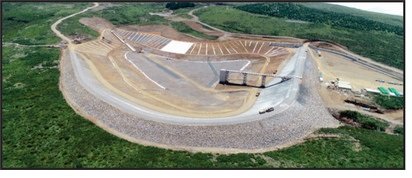
Figure 2: In the foreground the dam with shotcreted upstream slope, in the background the vertical anchorage trenches, at closer spacing in the top right corner, and the first geocomposite sheets under installation.
Before installing the waterproofing geocomposite, a 1000 g/m2 anti-puncture geotextile was placed over the most irregular surfaces (Figure 3a). Each sheet of geocomposite had a specific length and was placed at the exact position of the Geocomposite Layout. Adjacent sheets were watertight joined with double track seaming (Figure 3b). All field seams are controlled for watertightness with standard methods.
Decades of experience in lining of hydraulic structures have demonstrated that flexible PVC geomembranes with a bonded anti-puncture geotextile exhibit a better puncture and burst resistance and a friction angle against the subgrade higher than rigid HDPE geomembrane placed on a separate geotextile, because they better adapt to an irregular subgrade requiring less surface preparation, distributing on a larger surface the load exerted by water and reducing the risk of damage due to concentrated loads at protrusions (puncture) and cavities (burst). A flexible, low thermal expansion composite geomembrane (PVC geocomposite) would reduce the forces transferred to the anchorage lines and would not form large wrinkles (Giroud, 2005). Accordingly, the HDPE geomembrane and 1000 g/m2 geotextile of the original design were substituted by a single geocomposite SIBELON® CNT 3950, consisting of a 2.5 mm thick flexible thermoplastic PVC geomembrane heat-bonded during fabrication to a 700 g/m2 polypropylene geotextile.
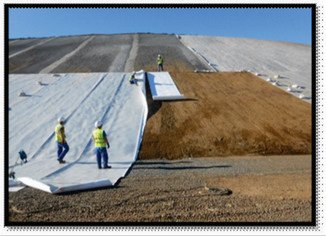

Figure 3a & 3b: At left an anti-puncture geotextile roll under
placement before being covered by the waterproofing geocomposite, at right
seaming of adjacent geocomposite sheets.
The batten strips fastening the
geocomposite to the concrete of the trenches are secured with chemical anchors
at appropriate spacing, and are equipped with watertight fittings preventing
water infiltration where the anchors cross the geocomposite. The batten strips
fastening the geocomposite to the shotcrete are secured with mechanical anchors
and are waterproofed with cover strips of the same geomembrane composing the
SIBELON® geocomposite (Figure 4a &4b).
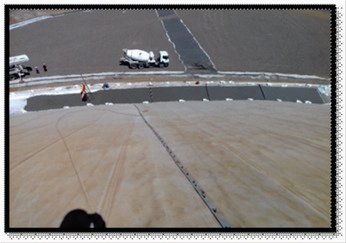

Figure 4a & 4b: At left the vertical batten strips fastened on the concrete trenches, at right waterproofing of the vertical batten strips on shotcrete.
Face anchorage of the geocomposite at
the berms, at the spillway platform, and at the feeding canal platform is made
by ballast with reinforced concrete slabs. Before casting the slabs, a
protection geotextile was placed on the geocomposite to prevent any possible
damage.
1.3 RESULTS
The waterproofing liner is confined at all peripheries by a continuous seal that is watertight and designed to prevent water infiltrating underneath the liner. The top perimeter seal is watertight against water at low pressure (rain) and is made by embedment in the top trench, as shown in Figure 4b. The submersible perimeter seals at all concrete structures, watertight against water in pressure, consist of stainless-steel batten strips secured to the concrete with chemical anchors at appropriate spacing, and conceived to be able to accept differential displacements, with a special “loop” configuration that allows reducing the stresses that can be created by a large displacement. Figure 5 shows the operation of the reservoir.
The contract schedule of
Pico do Urze reservoir was 90 days which includes installation plus a 2-week
allowance for bad weather. Waterproofing works started on July 8, 2019 and were
completed in 99 days, of which 21 days of bad weather, for a surface of about
82,400 m2. Using a geocomposite was a main factor allowing such fast
installation.
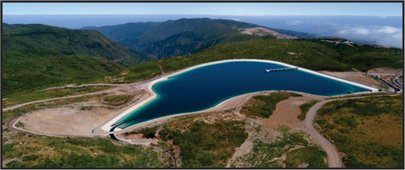
Figure 5: Pico da Urze reservoir in operation
2 WATERPROOFING OF UPPER BHAVANI MASONRY DAM
2.1 PROJECT DATA AND ORIGINAL DESIGN
Upper Bhavani Dam is a
masonry gravity dam built between 1959-65 and is located on the Bhavani river,
near the border between Tamil Nadu and Kerala at an elevation 2276.88 m. The Dam is Owned by Tamil Nadu Generation and
Distribution Corporation (TANGEDCO) and is one of the biggest hydro-electric
generating schemes in Tamil Nadu and is the main source of water for eight
hydro powerhouses that are constructed further down the hills of Nilgiris
.Figure 6 shows the geographical location of the upper bhavani dam. This is
located at the border of Kerala and Tamilnadu.

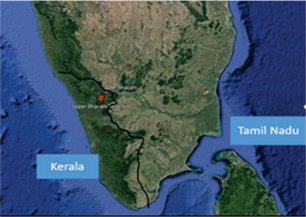
Figure 6: Geographical location of the Dam
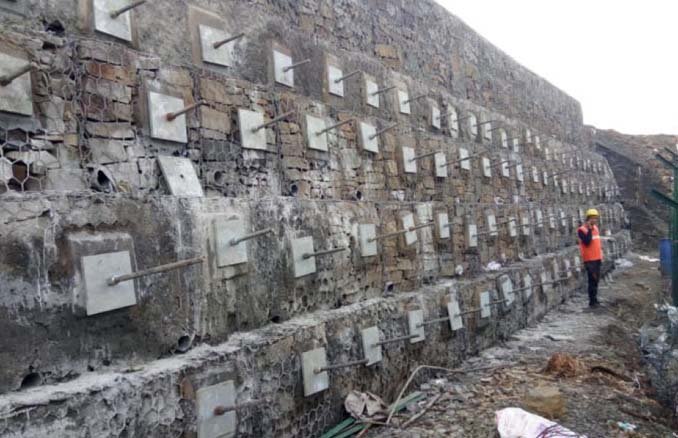
The dam, founded on hard granite rock, is 80 m high and 419 m long at crest. It has a 19.81 m long central gated spillway, and a 1.52 x 2.13m scourvent tower. The 13 vertical construction joints are spaced at 30.48 m. The upstream face, vertical from crest to El. 2264.70 in the non-overflow section and to El. 2258.60 in the overflow section, and 1H:10V in the lower part, is formed by random rubble masonry with raised pointing. The dam has a drainage gallery in the central part, with a minimum elevation of 2210.00, and a grout curtain. The maximum water level is at El. 2276.88, minimum drawdown level at El. 2249.42, sill level of scourvent at El. 2221.99.The masonry facing deteriorated over the years, resulting in decreased imperviousness, cavities in the rubble masonry pointing, and seepage through the dam, which emerged at the downstream face where the growth of small plants provided evidence of persisting leakage. High leakage was found in more than 8 shafts, increasing every year: about 8,000 l/minute were recorded as leakage coming only from the two shafts surrounding the spillway.


Figure 7a & 7b: Saturated Downstream side and water gushing through the gallery which goes beyond the measurable parameter
The client since the late 1990’s
attempted several leakages arresting methods like a) Primary Body Grouting from
Dam Crest b) Epoxy Pointing c) Shotcrete/ Guniting. Unfortunately, all efforts
turned futile as the problem experienced in the dam needs large-scale repair works and not a localized
repair solution. The leakage recorded in February 2019 when the water level was
at El 2264.5 was around 8200 Lpm (Liters /min) which was at 9 meters below Full
Reservoir Level (FRL). The leakage discharged into the gallery and the
downstream side reflects the condition o the dam. The leakage at the Full
Reservoir level was close to 15,000 Lpm. However, there is no measurement taken
during the FRL. With the quantum of water leaked, the client was deprived of nearly
30 Million Units of Power Per year.
Relief to TANGEDCO arrived when a large-scale rehabilitation was
proposed for Upper Bhavani dam. The Geomembrane solution approved by World
Bank, IIT Madras, and the client became the need of the hour for the dam.
Figure 7a & 7b shows the extreme
saturation observed on the entire downstream of the dam indicating heavy
pressure inside the gravity dam which causes a serious safety concern. Figure 5 shows the water gushing through the
gallery which prevents access by anybody. Knee deep of water was gushing out of
the gallery exit which goes unutilized to the downstream side of the dam.
2.2 INSTALLATION
The waterproofing system is the one widely adopted for masonry dams’ rehabilitation and discussed in the most important guidelines for geomembrane systems in dams (ICOLD 2010). The waterproofing liner is a flexible composite geomembrane, SIBELON® CNT 4400, consisting of a 3.0 mm thick SIBELON® geomembrane heat-bonded during extrusion to a non-woven, needle punched 500 g/m2 polypropylene geotextile. Before installation of the waterproofing liner, all anchorage lines was regularized by a layer of mortar. A strip of high-transmissivity drainage geonet was placed over the mortar and under the vertical tensioning profiles.

Figure 8 :- Preparation of mortar strips for placement of vertical
anchorages
Face anchorage of the waterproofing
liner is obtained by vertical stainless-steel tensioning profiles patented by
Carpi and allowing continuous linear fastening and pre-tensioning of the liner.
Figure 8 shows the preparation of the vertical strips to place the profile The tensioning profiles were placed at 5.70 m
spacing and waterproofed with a cover strip of SIBELON® C 3900 geomembrane (the
same 3.0 mm thick material composing the SIBELON® CNT 4400 geocomposite, but
without geotextile). Figure 9a shows With rough and protruding stones, it was
necessary to prepare a leveling mortar strip made with High Strength Mortar for
fixing the stainless steel profiles. Figure 9b shows there is a thick 200gsm
geotextile installed after the fixation and leveling of the mortar strip.
After the installation of Vertical anchorages, a layer of 2000 g/m2 nonwoven geotextile is installed over the upstream stone masonry facings. This protects the geocomposite from puncture as well as provide some drainage capability.

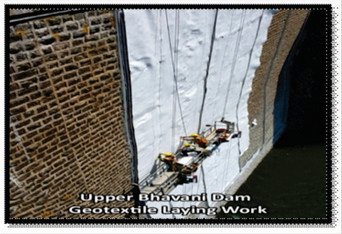
Figure 9a: Levelling of strip for fixing of profiles Figure 9b: Thick 2000 gsm geotextile
installed
The waterproofing membrane comes in
2.1 meters wide and several rolls of geocomposite are rolled one after the other as shown in Figure 10a&10b
All welding of the waterproofing liner and geomembrane cover strips was done by “hot air” one-track welding guns. The waterproofing liner is confined at all peripheries by mechanical seals that are watertight against water in pressure where submersible (along bottom peripheries, scourvent, spillway, at connections between horizontal sections) and against rainwater and waves at crest Submersible perimeter seals are made with 80x8 mm flat stainless-steel profiles tied to the dam with anchor rods embedded in chemical phials.

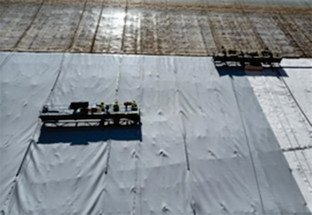
Figure 10a & 10b : Multiple rolls of geocomposite unrolled and hot
air welded together
Even compression is achieved with
EPDM rubber gaskets and stainless-steel splice plates. The perimeter seal at
the crest is made with 50 x 3 mm flat stainless-steel batten strips tied to the
dam with mechanical anchors. The same profiles, waterproofed with SIBELON® C
3900 geomembrane cover strips, keep the waterproofing liner taut to the dam
face at concave corners.
A double 1 m high band of drainage geonet along the bottom periphery of each horizontal section constitutes the bottom drainage collector, conveying water to pipes embedded in transverse holes drilled to reach the gallery. Anti-intrusion stainless steel plates in front of each discharge pipe, and ventilation pipes at the crest and to the gallery, complete the drainage system. An Optical Fibre Cable system was installed to implement the monitoring of the geomembrane system. Figure 11a &11b shows the Performance of the Geomembrane waterproofing system to be monitored using a special Optical Fiber Cable using the Heat Pulse method (HPM).
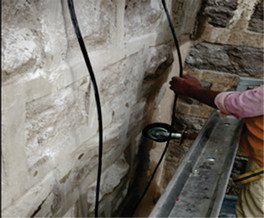
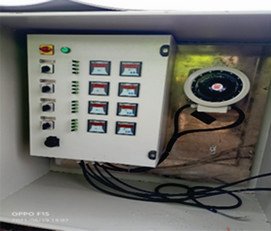
Figure 11a &11b: Optical Fiber cable installed along the entire
periphery of the dam
The project was executed in 3 phases
in spite of the pandemic spread in two out of the three seasons. The details of
the project to be installed are explained below
Phase I started in the month of February 2019 and completed in the month of June 2019 during this period of 4 months most of the time was spent on the preparation and repairing work of the surface of the dam depleted and only 20% of the geomembrane was installed. That is almost 3950sqm of the geomembrane was installed at the surface of the dam. It started from the top left corner of the upstream side.The geomembrane rolls are terminated to the dam face by using a special watertight seal made of thick Stainless Steel (80x8mm) material. The geocomposite sheets from the top is connected to the perimeter seal at the bottom and high bonding resin is used with rubber gaskets and seals to prevent the entry of water from the bottom Geomembrane is a loosely coupled system and hence prevention of vacuum is an important design aspect. To avoid the formation of vacuum, carefully designed ventilation pipes are installed to allow air to enter into the area between the dam face and the geomembrane. This prevents the formation of vacuum and avoids the risk of puncturing by high impact objects in the floating water. Figure 12a, 12b, and 13 show the installation of the geomembrane with ventilation pipes and working with full safety.
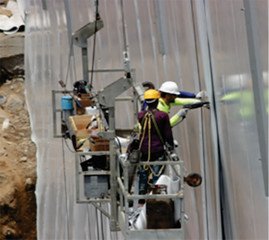
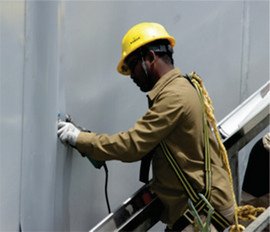
Figure 12a&12b :-Shows the
installation of the geomembrane with full safety
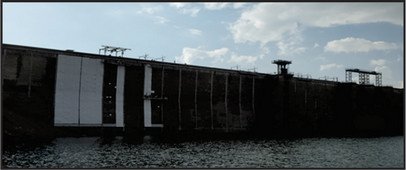
Figure 13 :- Installation of Geomembrane on the divided sections
Phase II started in January 2020 and
completed in the month of June 2020. Within the period of 6 months, 30% of
geomembrane installation was completed. That is almost 5490 sqm of the
geomembrane was installed at the surface of the dam. The entire geomembrane
work was carried out during the first wave of the global pandemic. In spite of
severe restriction, the resilience of the crew made it possible.
Phase III started in the month of Dec 2020 and was completed in June 2021 during this period of tie almost 50% of geomembrane was installed that is at the lower parts of the dam, covering up to the area of 9150 sqm, The third phase was commenced once the monsoon ends. Despite the challenges of extreme cold weather and the location of the dam in a deep reserved forest and the threat of extremists, work has been completed in the third phase. The water from the Upper Bhavani Dam acts as the main source for a series of cascaded powerhouses with a total power generation capacity of 600 MW. Thus saving water is of utmost importance for the client TANGEDCO (Tamil Nadu Generation and Distribution Corporation Ltd). Some of the works in phase 3 had to be done in underwater condition as heavy rainfall combined with cofferdam collapse made it mandatory to engage underwater divers and installation proceeded with special divers and diving equipment.
The monsoon in the Upper Bhavani
basin, as historically recorded, is severe especially between June and August,
when no work is possible at all. Moreover, due to the elevation, the
temperature from December to February easily reaches 5 – 6 °C during the day
and drops sometimes below zero °C during the night, limiting the activities on
site. campaigns, one in 2019 and one in 2020. The breakthrough of the pandemic
Covid 19 virus, and an exceptionally rainy monsoon in 2020, required modifying
the original schedule and splitting the waterproofing works over three
campaigns.
2.3 RESULTS
The shafts which were contributing to the maximum leakage are completely watertight now. With the water level on 16th October 2021 at El 2265, the two shafts which were leaking in the order of 8200 Lpm are now reduced to less than 60Lpm (99% Savings). The downstream of the dam appears dry and there is no major discharge of water inside the gallery as of 16th Oct 2021. The waterproofing of the entire dam resulted in an additional generation of 30 Million Units of Power per year. Figure 14 show the proof of completion of all the phases.
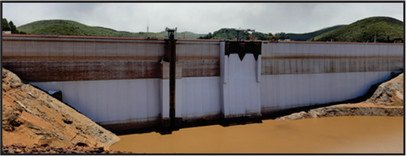
Figure 14. Upper Bhavani on June 30th 2021: fully lined
The result of the waterproofing was immediately seen with the water level raising fast, the leakage in the two shafts becomes negligible. Below figure 15 and 16 shows the comparison of the area where there was leakage before and after installation of the geomembrane. Graph 1 shows the details of the quantity of the water leakage before and after installation of geomembrane.

Figure 15 :- Shows the Vertical Drain Shaft (Right Spillway)Before and after Geomembrane Installation
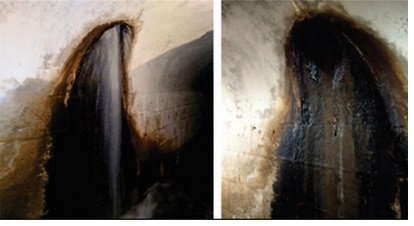
Figure 16:- Shows the Vertical Drain Shaft (Left spillway) Before and After Geomembrane Installation

Graph 1 :- Shows the details of the quantity of the water leakage before
and after installation of geomembrane.
3. CONCLUSION
The effective design combined with the right selection of the waterproofing system assists the aging dams to extend the service life by additional decades. Upper Bhavani is a classic example of how the design is flexible enough to adapt to dynamic environment needs without any compromise on the result. The geomembrane sealing also helps to contribute to reducing alkali aggregate reactions
The main advantage of the installed
system in the upper Bhavani Dam is that at any point in time, the installation
can be completed logically and restarted again depending upon the monsoon
condition and client needs with minimal financial impact. The performance of
the above applications has shown that exposed geomembrane systems, adequately
designed and installed, provided a technically effective solution to restore
imperviousness in the dam body by controlling the seepage of the dam. The dam
started impounding on 1st July 2021 and with the water level nearing Full
Reservoir level (FRL) the results are very satisfying to the client TANGEDCO as
well as Carpi.
Exposed geomembrane at Pico Da Urze reservoir not only allowed for faster installation it also allowed the owner the flexibility to monitor the function of the geomembrane visibly through the naked eyes by just lowering the water level which is unlikely in bituminous or any other face layer that are permanently adhered to the substrate. The reservoir, impounded in January 2020, performs according to expectations of the client.
REFERENCES
1. Giroud, J.P. and Soderman, K.L. Comparison of Geomembranes Subjected to Differential Settlement. Geosynthetics International, 1995, Volume 2, No. 6.
2. Giroud, J.P. Quantification of geosynthetic behaviour. Geosynthetics International, 2005, Volume 12, No. 1.
3. IRENA - International Renewable Energy Agency. Innovative operation of pumped hydropower storage. Innovation landscape brief. IRENA 2020.
4. ICOLD Bulletin 135- Geomembrane Sealing System for Dams
Related Articles
Current Issue

10-2026
