


Transforming Job-Site Efficiency: The Power of On-Site ProcessingInterview with Mr. Guido Azzolin, CEO, MB Crusher

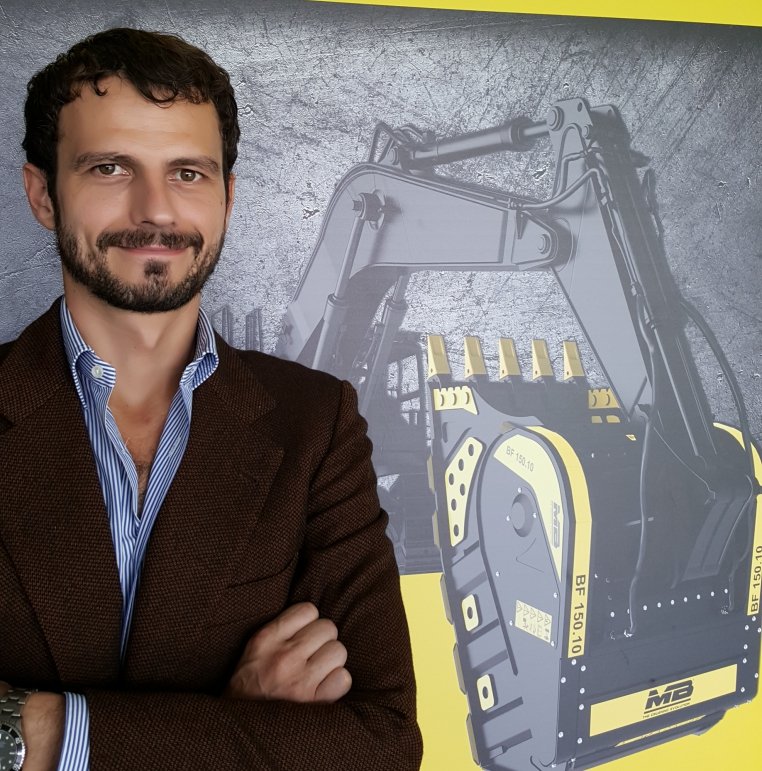
Guido Azzolin
CEO, MB Crusher

Could you explain the major product categories offered by MB Crusher, such as crusher buckets, screening buckets, shaft screeners, drum cutters, sorting grapples, etc., and how they help make construction and demolition work easier and more efficient?
Every attachment in our range starts from one question: what does this site need to do with its material, and can the excavator already working there do it?
The crusher bucket is where MB began in 2001. It is a jaw crusher mounted on the carrier that takes concrete, rock, asphalt or demolition rubble and reduces it in a single pass to a size the operator sets. The screening bucket works alongside it, separating material before or after crushing through interchangeable grids, so one machine can produce two or three usable grades. Shaft screeners do similar work on soil and on wet, cohesive material that would clog a mesh. Drum cutters mill rock and concrete with control where breaking or blasting is not acceptable. Sorting grapples, with full rotation and interchangeable claws, handle segregation on demolition and recycling jobs, and our demolition pulverizers bring the first stage of demolition into the same family.
What changes on site is the sequence. Conventionally, material leaves as waste and returns as purchased aggregate, with trucks, permissions and waiting time in between. With attachments, demolition, sizing, screening and reuse happen at the work front, handled by one operator on a carrier the contractor already owns. Indian sites rarely have space, time or road access to spare, and that is where the difference is felt.
The equipment is the means. The real gain is control over material and schedule.
How do products like MB-HDS shaft screeners and MB-R drum cutters enhance efficiency and productivity in excavation, road construction, and material recycling?
Both machines solve problems that conventional methods handle awkwardly.
The MB-HDS shaft screener uses rotating shafts instead of a fixed mesh. As the shafts turn, fine material drops through while the rotation keeps lifting and moving the oversize, so the screening surface does not blind. That matters in India, where excavated soil is moist, clayey or mixed with roots and stones for much of the year. Shaft kits can be changed on site, so the same attachment can produce pipe bedding one week and screened topsoil the next, utility and road jobs, excavated spoil is screened and returned to the trench as bedding or backfill instead of being trucked away and replaced.
The MB-R drum cutter addresses the opposite problem: hard material that must be removed precisely. Its Direct Drive Twin Motor System transmits power straight to two drums and distributes it according to the load, with an integrated power boost when the cutter head meets harder rock. Because it mills rather than impacts, vibration and noise stay low, which counts in tunnels, beside existing structures and on urban sites where blasting or heavy breaking is restricted. The profile comes out cleaner, so there is less overbreak to fill and less rework.
In both cases, productivity comes from doing the job once, correctly, at the point of work.

Instead of relying entirely on separate crushing plants and material transportation, what key cost savings and productivity benefits can customers achieve by using MB Crusher attachments?
The clearest way to answer this is to follow the material. On a conventional job, demolition debris or excavated rock is loaded, hauled and tipped, while fresh aggregate is bought, hauled back and placed. Every leg carries cost in trucks, fuel, disposal charges, permits and supervision. Every leg also carries risk. A transport strike, a quarry closure or an access road damaged in the monsoon can stop a site that is otherwise ready to work. In hill regions, the Northeast or island locations, haulage often decides the economics of the entire project.
An attachment shortens that loop. The material already on site becomes the input. The crusher bucket draws its power from the carrier’s hydraulic circuit, so there is no separate engine, no plant mobilisation, no foundation and no dedicated crew. One operator crushes, the same machine screens, and the output goes straight back into the work as sub-base, backfill or bedding. The equipment moves with the work front instead of the work front waiting for material to arrive.
The savings are structural rather than marginal: fewer truck movements, less purchased aggregate, less disposal, fewer people and machines on the job, and much lower exposure to supply interruptions. The contractor also gets more productive hours from an excavator he has already paid for.
In my experience, material cost overruns on Indian sites rarely come from the price of aggregate itself. They come from the logistics around it. Processing at source removes that cost instead of trying to negotiate it down.
What new technologies, product innovations, or business opportunities do you think will shape the future of your company in India?
I see three forces shaping the next phase, and they apply to the sector as much as to us.
The first is mechanisation at the work front. Labour availability and skill levels are real constraints on Indian sites, and contractors want one trained operator to accomplish what once needed a larger crew. Attachments fit that direction naturally, because they multiply what a single carrier can do across the life of a project.

The second is how recycled material is treated in specifications. India has had dedicated C&D waste rules since 2016, and the framework has continued to evolve. The real shift will come when recycled aggregate is routinely accepted in tender specifications and quality norms, so that on-site processing is designed into a project from the start rather than added later.
The third is the carrier itself. As OEMs supply machines with hydraulic circuits configured for attachments, and with telematics that log working hours, the gap between owning an attachment and using it productively narrows. Hour monitoring also turns maintenance from reactive to planned.
On our side, innovation keeps coming from field data, refining wear parts, hydraulic protection, noise and vibration control across the existing range, and from new families. Our demolition pulverizers, with interchangeable jaw kits and continuous rotation, extend the range into primary demolition, so a contractor can take a structure down and process the debris with the same carrier.
The machines will keep evolving. The principle will not: handle material where it is.

Related Articles


Current Issue

11-2026
