


Smart, Sustainable & Scalable The Future of Paver Block Manufacturing-Q Green Techcon Ltd.

How does your technology support eco-friendly paving solutions?
At Q Green Techcon, sustainability is something we have consciously built into our machines from the design stage itself. It’s not treated as an add-on.
Through our RT Series concrete block and paver block machines, we enable efficient use of materials like fly ash, while also ensuring that the overall production process remains optimized in terms of energy and material usage.
We have seen that when production is controlled and efficient, it naturally reduces wastage and improves product life. Our compaction technologies also help in producing more durable blocks, which contributes to longer lifecycle performance and that, in a very practical sense, supports sustainable construction.
Are your systems optimized for fly-ash or sustainable materials?
Yes, absolutely. In fact, a large part of our system design today is aligned with the growing use of fly ash and other sustainable materials.
From our experience working with different manufacturers, one of the key challenges is handling variations in raw materials. Our systems are designed to manage this through controlled processes, ensuring consistent density and strength even with fly ash-based mixes.
As the industry moves more toward waste utilization and environmentally responsible practices, we see this becoming the standard - and our solutions are already built keeping that in mind.
What production advantages do your machines offer over conventional setups?
The biggest difference we see between conventional setups and modern systems is the level of control and consistency.
With our RT Series machines and Wet Press technology, manufacturers are able to achieve:
More consistent production output
Better dimensional accuracy and finish
Lower rejection rates
Reduced dependence on manual intervention
From what we have observed across our installations, once manufacturers shift to automated systems, the improvement is not just in output, but also in overall process stability and predictability. That’s where the real advantage lies.
How do you balance automation and cost efficiency?
This is something we discuss quite often with our customers. Automation should not feel like an added cost, it should make operations simpler and more efficient.
At Q Green, we try to keep this balance by offering modular and scalable solutions, so that customers can expand as their requirements grow.
We also integrate systems like SCADA-based monitoring, which help in better control without complicating operations. Over time, this actually helps reduce wastage, downtime, and maintenance costs.
In our experience, when automation is implemented thoughtfully, it doesn’t increase cost - it improves overall efficiency and long-term returns.
Which market segments mostly use your solutions?
Our solutions are used across a wide range of segments within the construction industry.
These include:
Paver block and concrete product manufacturers
Infrastructure and road development contractors
Real estate and urban development projects
Government and public infrastructure initiatives
We are also seeing a growing number of organized and large-scale manufacturers moving toward automated systems, especially when they need consistent quality at higher volumes.
What sustainability-focused solution are you presenting at ICCBP 2026?
At ICCBP 2026, we are focusing on solutions that bring together practical sustainability and reliable performance.
We are showcasing:
Our RT Series machines designed for fly ash-based production
Advanced Wet Press technology that improves density and dimensional accuracy, leading to longer-lasting products
Systems that help in better material utilization and reduced wastage
Our idea is simple- sustainability should not come at the cost of efficiency. It should work alongside it.
How does participation in ICCBP support green technology awareness?
Platforms like ICCBP are important because they bring together people who are actually working in the industry - manufacturers, technology providers, and decision-makers.
For us, it’s an opportunity to share what we are doing on the ground, and also understand how others are approaching similar challenges.
It helps in creating more awareness around practical, implementable green technologies, rather than just theoretical concepts. And over time, these conversations play a big role in moving the industry toward more responsible and sustainable practices.

Current Issue
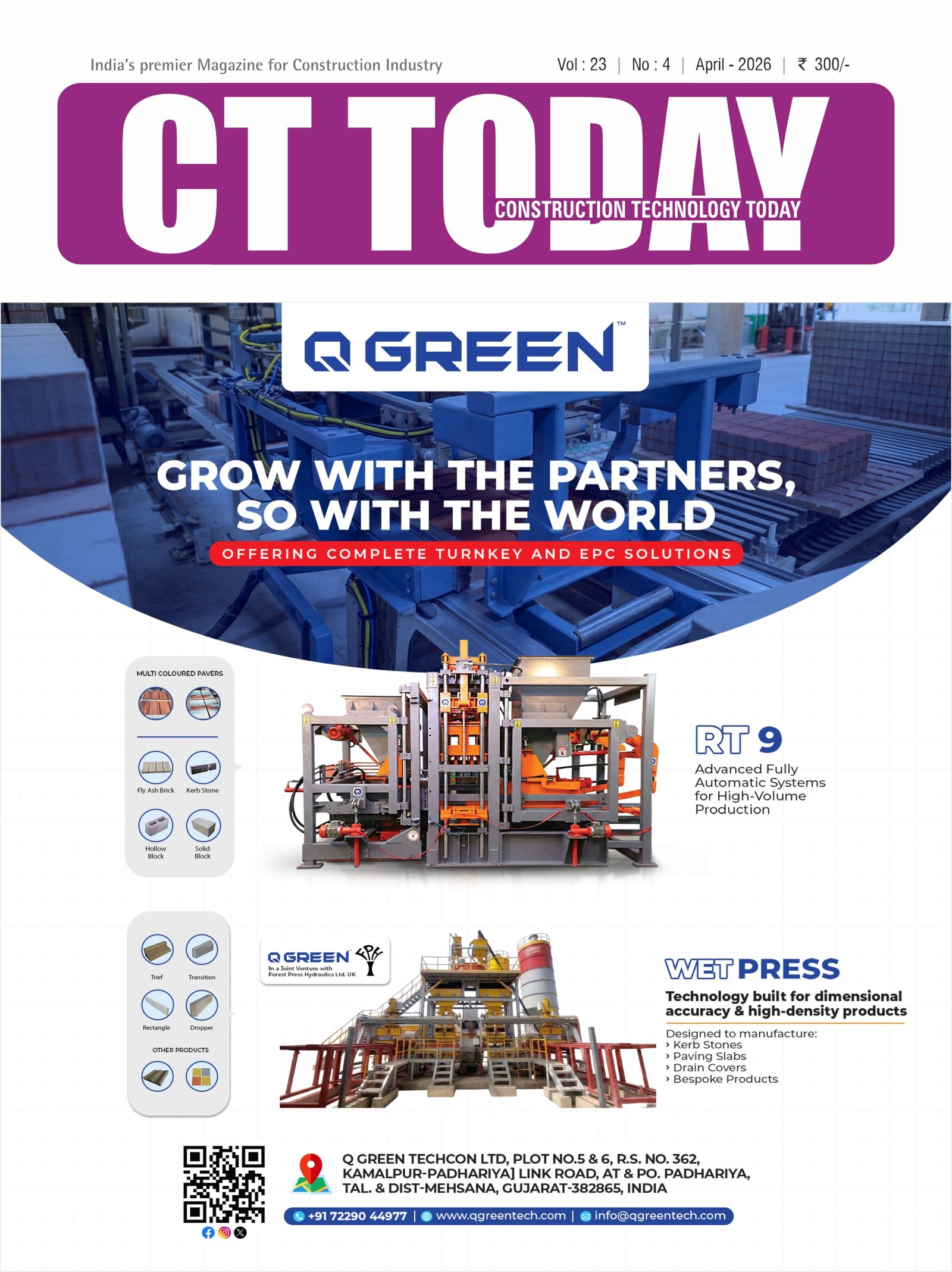
04-2026
