


Transforming India’s Construction Industry with Advanced Crushing, Screening & Washing Technologies
Introduction
India’s construction sector is growing rapidly, driven by major infrastructure projects, urbanisation, road development, rising housing demand, and the need for quality aggregates and manufactured sand (M-Sand). With construction activity expanding, efficient material processing has become increasingly important. Crushing, screening, and washing equipment now plays a key role in modern aggregate production, helping contractors and quarry operators process natural stone, recycled materials, and sand more efficiently and consistently while meeting quality standards.
The latest generation of equipment is
moving beyond traditional mechanical processing, with a focus on
higher-capacity, mobile and modular plants, greater automation, hybrid and
electric power, intelligent monitoring, and more efficient washing and
classification. Recent developments include hybrid crushing and screening
machines that can run on either grid electricity or an onboard generator.
Digital monitoring is also becoming more common, helping operators track
equipment condition and vibration in real time, identify issues early, and
improve predictive maintenance.
These technologies are especially
important in India, where equipment must deliver high productivity while
handling different raw materials, tough operating conditions, and
transportation challenges. Along with this, there is also mounting pressure to
reduce fuel and water consumption and keep operating costs under control.
Modern integrated plants tackle these challenges by combining crushing,
multi-stage screening, washing, and water-recycling systems to consistently
produce high-quality aggregates and M-sand for infrastructure and construction.
This evolution is also reflected in
equipment designed for the Indian market. New crushing technologies are being
developed and manufactured in India for both domestic and neighbouring markets.
Additionally, the use of data and sensor-based analysis in advanced screening
technology is rapidly increasing to detect performance and maintenance-related
issues at an early stage; this helps operators enhance reliability and
alleviate downtime.
Against this backdrop, next-generation crushing,
screening and washing equipment is playing an increasingly important role in
helping India’s construction and aggregates industry improve productivity,
enhance product quality, use resources more efficiently and move towards more
sustainable operations.
Integrated Crushing, Screening & Washing for High-Quality Aggregates
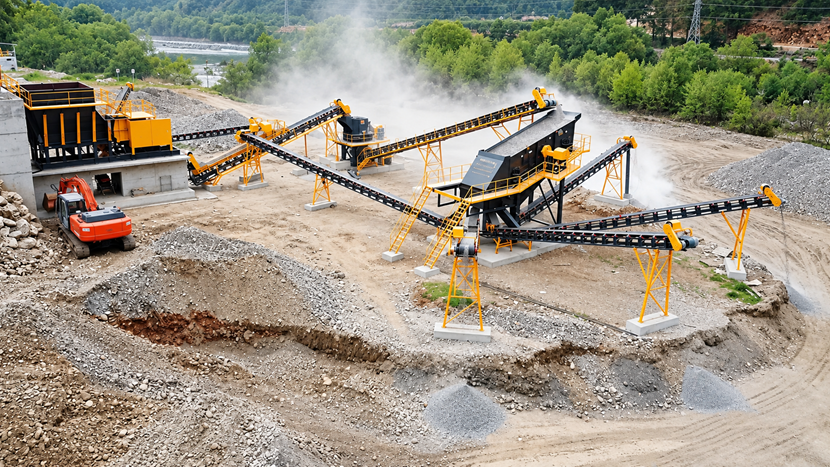
Crushing, screening, and washing equipment play a vital role in India’s construction and infrastructure sector. These machines are used to process raw materials such as stone, rock, aggregates, and sand, turning them into high-quality materials that can be used in construction. Together, they help ensure that these materials meet the required size, shape, cleanliness, and quality standards for a wide range of applications, including roads, bridges, concrete production, railways, and other major infrastructure projects.
Crushing equipment is designed to break
down large rocks and other raw materials into smaller, more manageable sizes.
The type of crusher used depends on the material and the specific application.
Common options include jaw crushers, cone crushers, impact crushers, and
vertical shaft impact (VSI) crushers, each serving a different role at various
stages of the crushing process.
Screening equipment separates crushed material
into different size ranges. Vibrating screens and other screening systems help
producers sort and classify aggregates based on specific size requirements.
This ensures that the final material is consistent and suitable for its
intended construction application.
Washing equipment plays an important role
in cleaning aggregates and manufactured sand by removing unwanted materials
such as dust, clay, silt, and other impurities. Equipment such as sand washers,
log washers, and dewatering screens can be integrated into processing plants
where a higher level of material cleanliness is required. This helps produce
cleaner, higher-quality end products that are better suited for a wide range of
applications.
These three stages are commonly integrated
into aggregate and mineral processing plants across India. By combining
crushing, screening, and washing, producers can achieve more consistent
material quality, meet specific project requirements, and make better use of
locally available resources. The right equipment and process setup will depend
on several factors, including the type of raw material, required production
capacity, target product sizes, moisture content, and the overall needs of the
project.
Emerging Technologies Shaping India’s Equipment Market
India’s construction sector is undergoing
a significant transformation, with technology playing an increasingly important
role in improving productivity, minimising operating costs, and keeping pace
with the country’s growing infrastructure and urban development needs. These
shifts are also shaping the demand for crushing, screening, and washing
equipment, with several key trends emerging across the market:
●
Automation
& Intelligent Equipment: Modern crushing & screening plants are
becoming smarter and more connected. With automated controls, remote
monitoring, sensors, and real-time performance data, operators can keep a
closer eye on the plant, optimise production, identify potential equipment
issues early, and reduce unexpected downtime.
●
Higher
Emphasis on Mobility: Mobile and tracked crushers and screens are becoming
increasingly useful for projects where equipment needs to move between sites or
work closer to construction areas. Their flexibility can help reduce the need
to transport materials over long distances while allowing projects to get up
and running more quickly.
●
Advanced
Screening Technologies: High-frequency screens, modular screening media, and
improved vibration systems are increasingly being used to make the screening
process more consistent and efficient. Better control over particle size is
especially important for producing aggregates that meet the increasingly
specific requirements of modern construction projects.
●
Recycling
& Circular Construction: As awareness around construction and demolition
waste continues to grow, more attention is being given to crushing, screening,
and washing systems for producing recycled aggregates. Equipment that can
efficiently process concrete, asphalt, and other recovered materials helps turn
waste into useful resources while reducing the need for virgin aggregates and
supporting more sustainable construction practices.
●
Digitalization
& Predictive Maintenance: IoT-enabled equipment can continuously monitor
important factors such as operating hours, temperature, vibration, fuel or
energy consumption, and the condition of key components. By analysing this
data, predictive-maintenance systems can detect early signs of potential
problems, allowing issues to be addressed before they turn into costly or
serious breakdowns.
●
Modular &
Customized Plant Configurations: Contractors and aggregate producers are
increasingly looking for plants that can be tailored to their specific feed
materials, production capacities, and end-product requirements. Modular systems
offer the added advantage of making it easier to expand or adapt the plant as
demand changes over time.
Overall, technology adoption in India’s construction and aggregates industry is no longer just about increasing production capacity. As the industry evolves, factors such as automation, energy efficiency, water conservation, recycling, digital monitoring, and environmental management are playing a much bigger role in the way companies choose crushing, screening, and washing equipment.
Smarter, Greener & More Connected Solutions for India’s Future
India’s crushing, screening and washing
equipment sector is moving towards smarter, cleaner and more connected
solutions. The next generation of plants will increasingly combine AI-driven
automation, IoT and telematics, predictive maintenance, electrification and
hybrid power systems. Together, these technologies can help operators improve
productivity, reduce fuel consumption and emissions, and bring down overall
operating costs.
Some of the key developments likely to shape
the future are:
●
AI &
Automation: Intelligent control systems will play an increasingly important
role in optimising crushing, screening and feeding processes, helping operators
maintain consistent output while reducing the need for manual intervention.
●
Electric
& Hybrid Equipment: Diesel-electric and hybrid machines are gaining
traction in India, especially as businesses look for ways to reduce fuel
consumption, emissions and overall operating costs.
●
C&D Waste
Recycling: As India moves towards a more circular construction economy,
technologies that can turn demolition waste, old concrete and excavated
materials into reusable aggregates and sand will become increasingly important.
●
Digital &
Modular Plants: Connected, modular and mobile systems will provide plants
greater flexibility, enable faster deployment and help teams make smarter,
data-driven decisions to optimise operations.
In the years ahead, competitive advantage will depend on much more than equipment capacity alone. Smarter, more energy-efficient and digitally connected material-processing solutions will play an increasingly important role. For India’s construction sector, this shift can help equipment owners improve uptime, plan maintenance more effectively, reduce cost per tonne and produce aggregates more sustainably.


Current Issue

10-2026
