


M-Sand will increase the demand of Crushing & Screening Equipment

Natural river sand is the most preferred choice as a fine aggregate material in producing cement mortars and cement concrete mixes. River sand is a product of natural weathering of rocks over a period of millions of years. The natural river sand is one of the cheapest resource of sand material available. However, the excessive mining of river bed to meet the increasing demand for sand in construction industry has led to the ecological imbalance in the country. The indiscriminate mining of sand from riverbeds is posing a serious threat to environment such as erosion of riverbed and banks, triggering landslides, loss of vegetation on the bank of rivers, lowering the underground water table etc. Hence, sand mining from riverbeds is being restricted or banned by the authorities in many places. Also, now a days sand available in the river bed is very coarse and contains very high percentage of silt and clay, the silt and clay present in sand reduces the strength of the concrete blocks and holds dampness.
Natural river sand is becoming a scarce commodity and hence exploring alternatives to it has become imminent. A few alternatives have come up for the industry to bank on of which manufactured sand or M -sand, as it is called is found to be the most suitable one to replace river sand. Manufactured sand, which is obtained by crushing the rock, is in use for quite some time in developed countries. The use of this sand is picking up in India in major cities. Use of scientifically produced manufactured sand as an alternative to river sand is the need of the hour and will provide a long term solution to Indian construction industry.
M-sand brings in better economies for business, by replacing the cost in effective river sand; it provides better concrete quality compared to concrete produces using river sand or crushed stone dust; reduces concrete production cost by saving approximately 20 per cent cement consumption, and also saves cost on water and admixtures. Moreover, the gradation in M-sand is far superior, thus the consumption of cement and water is relatively lower. M-sand enhances the strength and durability of the casting produced. M-sand is the inevitable future. With or without the imposed river sand mining ban - M-sand has established commercial value for small and large projects cutting across diverse sectors: namely, stone crushing, ready-mix concrete, real estate, infrastructure, hydro-power, and other related construction sectors.

Properties and Advantages of Manufactured Sand for Concrete Construction
Higher Strength of Concrete
The manufactured sand has required gradation of fines, physical properties such as shape, smooth surface textures and consistency which makes it the best sand suitable for construction. These physical properties of sand provide greater strength to the concrete by reducing segregation, bleeding, honeycombing, voids and capillary.
Thus, required grade of sand for the given purpose helps the concrete fill voids between coarse aggregates and makes concrete more compact and dense, thus increasing the strength of concrete.
Durability of Concrete
Since manufactured sand (M-Sand) is processed from selected quality of rock, it has the balanced physical and chemical properties for construction of concrete structures.
This property of M-Sand helps the concrete structures withstand extreme environmental conditions and prevents the corrosion of reinforcement steel by reducing permeability, moisture ingress, freeze-thaw effect increasing the durability of concrete structures.
Workability of Concrete
Size, shape, texture play an important role in workability of concrete. With more surface area of sand, the demand for cement and water increases to bond the sand with coarse aggregates.
The control over these physical properties of manufacturing sand make the concrete require less amount of water and provide higher workable concrete. The less use of water also helps in increasing the strength of concrete, less effort for mixing and placement of concrete, and thus increases productivity of construction activities at site.
Less Construction Defects
Construction defects during placement and post-concreting such as segregation, bleeding, honeycombing, voids and capillarity in concrete gets reduced by the use of M-Sand as it has optimum initial and final setting time as well as excellent fineness.

Economy
As discussed above, since usage of M-Sand has increased durability, higher strength, reduction in segregation, permeability, increased workability, decreased post-concrete defects, it proves to be economical as a construction material replacing river sand.
Installation of M-sand production plant near to project site can also save transportation cost in many cases compared to that involved in case of transporting river sand.
Eco-Friendly
Usage of manufactured sand prevents dredging of river beds to get river sand which may lead to environmental disaster like ground water depletion, water scarcity, threat to the safety of bridges, dams etc. to make M-Sands eco-friendlier than river sand.
Production Process of M-sand
The particle shape of the aggregates is very important for making concretes. It is a well-known fact that the sand having cubical particles with grounded edges gives higher tensile strength and compression strength to the concrete. The grains should be of durable material and the size of the grains must be such that it should give minimum voids. The presence of clay and slit is avoided since it retards the setting of the cement and making mortar.
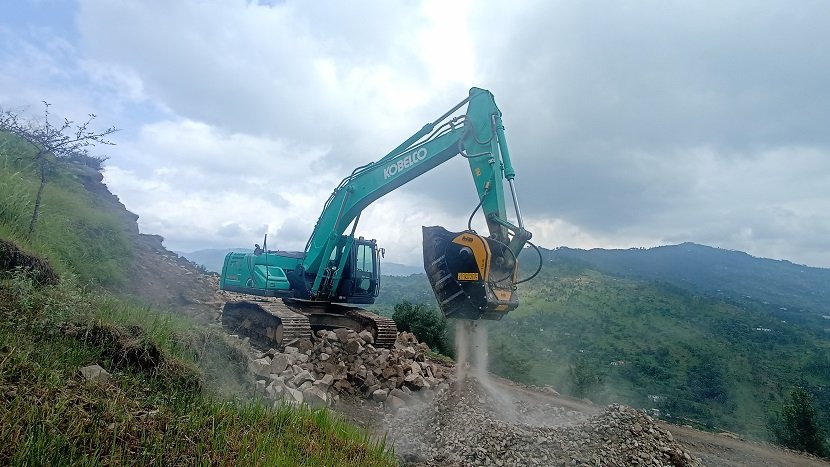
Manufactured Sand is produced by feeding hard stones of varying sizes to primary and secondary crushers (Jaw crusher and Cone crusher), for size reduction and these crushed stones are further crushed in Vertical Shaft Impact (VSI) crusher to reduce the particle size to that of sand. The VSI crusher by its unique design and action of attrition produces well shaped fine aggregate particles that are cubical and angular. The process of attrition also enables the reduction of surface roughness of the fine aggregate particles to some extent.
From the VSI stage, the sand has to further go through different stages of screening for proper grading ensuring better particle size distribution and process of elaborate washing to remove dust and flaky particles. By washing, the percentage of micro fines (passing 75 micron) is controlled below 15% by weight. The washing facility also provides keeps the manufactured sand in wet or partially wet condition. This will help to reduce the water absorption rate by manufactured sand during concrete manufacturing and hence better workability and workability retention.
Generally, manufactured sand is classified as Zone I, Zone II, Zone III and Zone IV (i.e. coarser to finer). There is sieve designation for each zone. Gradation is made in accord with the usage of the sand. There are testing sieves, consists of 4.75mm, 2.36mm, 1.183mm, 600microns, 300 microns and 150 microns. Zone I sand is used for concreting while sands Zone II to IV are used for plastering
Related Articles



Current Issue
11-2026
