


LANXESS pigments color 3D-printed concrete sculpture at Venice Architecture Biennale
• New design options through colored iron oxide
pigments in 3D concrete printing
• Artwork
“Duality of Skin and Core” sets new standards for sustainable construction and
circular design principles
Inorganic pigments from
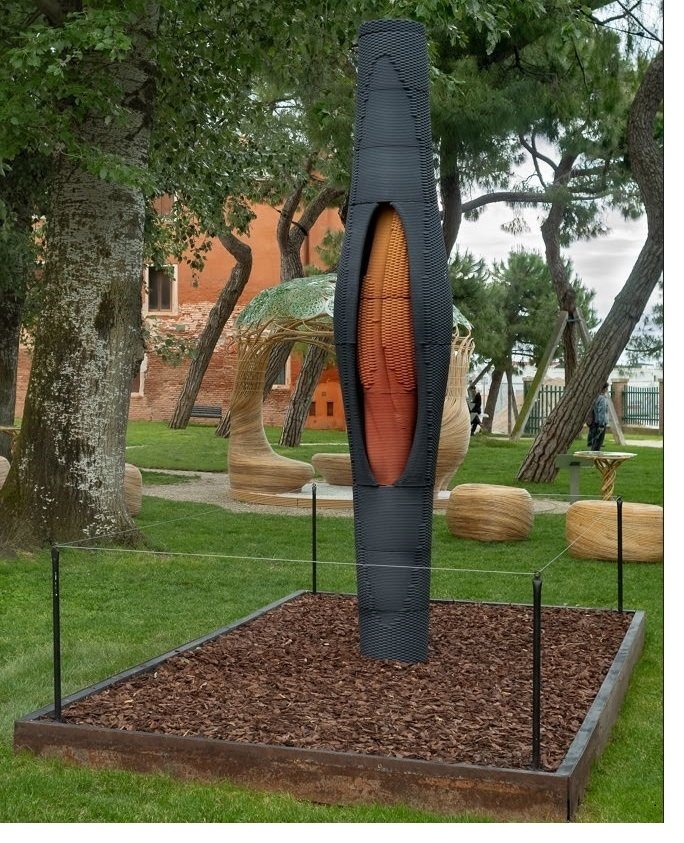
LANXESS are opening up new design possibilities in 3D concrete printing. A
current example is the concrete sculpture “Duality of Skin and Core,” which was
designed using red and black iron oxide pigments. It is currently on display in
the “Time. Space. Existence.” exhibition at the Venice Architecture Biennale.
Assistant Professor Cristina Nan and architect Mattia Zucco from the Department
of the Built Environment at Eindhoven University of Technology developed the
concrete sculpture as an architectural experiment. The modular column was
realized in collaboration with LANXESS and Dutch 3D printing specialist
Vertico.
The project shows how
color, computer-generated patterns, and material performance can be integrated
into digitally controlled manufacturing processes. This opens up new aesthetic
and constructive approaches for the architecture of tomorrow.
Innovative
design and materiality in 3D concrete printing
“Duality of Skin and Core”
reinterprets the classic architectural column. A slit-like opening in the
cladding reveals the colored interior – hence the name. Until now, a
monolithic, gray aesthetic has dominated comparable applications. The
innovative design and manufacturing strategy significantly expands the
possibilities of 3D printing with concrete. Instead of printing components in a
single pass, the project pursues a modular strategy. Inspired by ancient Greek
and Roman columns, the artwork consists of nine drums and four wings. Each
individual element weighs less than 30 kilograms. This principle facilitates
transport, enables flexible assembly, disassembly, and reuse, and thus extends
the life cycle of the components – an important contribution to sustainable
construction and circular design principles.
LANXESS
as a driver of innovation in 3D concrete printing
In order to secure the
potential of colored concrete in 3D printing, not only in terms of design but
also in terms of technology, LANXESS is conducting research into the properties
of its pigments under additive manufacturing conditions in collaboration with
partners such as the Institute of Construction Materials at the Technical
University of Dresden. As part of joint investigations, the partners have
analyzed how Bayferrox and Colortherm pigments behave in 3D concrete printing.
The results show that the pigments do not affect the concrete properties and at
the same time enable high color quality and consistency. They can therefore be
used without restriction for the individual coloring of the up to now mostly
gray material in 3D printing.
Related Articles




Current Issue

10-2026
