


Prefabricated Construction Taking Construction to the Next Level
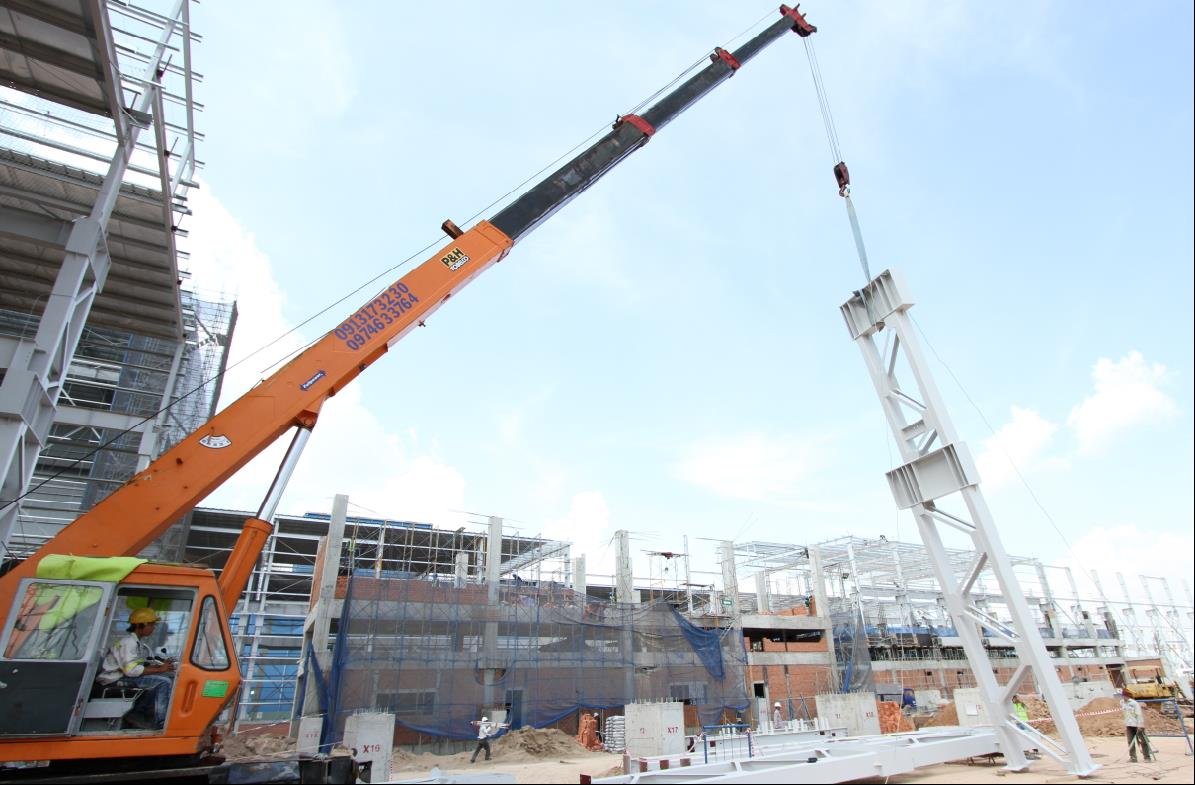
The construction industry is quickly adopting advance and innovative construction techniques to address the issues related to cost, quality, economy, labour, time, safety, sustainability etc. encountered in traditional construction methods or techniques. One such innovative technology that is widely trending in construction industry, especially in building construction is Prefabricated (Prefab) Construction.
Traditional on-site construction is described as linear construction, where each individual step is not only constructed entirely/ largely on site, but also needs to be completed before the project can move on to the next phase. Such construction has major implications in terms of time, cost, quality, safety, noise, pollution, manpower etc.
Whereas, the concept of prefabrication in construction corresponds to elements, parts or entire buildings produced off-site in a factory and transported to a construction site for a quick installation. Off-site constructions offers enormous opportunities , which not only overcomes the disadvantage of traditional construction, but also offer distinct advantages in terms of cost, time, quality, safety, labour, environment, materials etc.
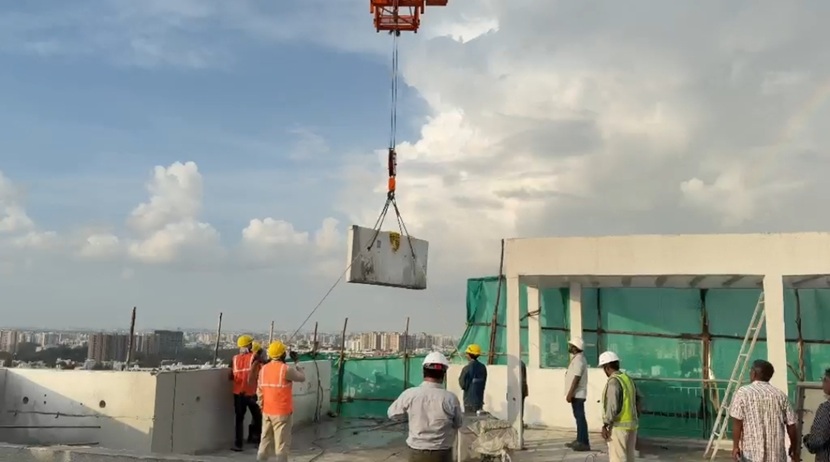
With prefabrication, it is possible for the base work to take place while the rest of the structure is built in the factory. At the construction site, the process is fast and is usually carried out using heavy machinery to lift the structures. Less construction time, greater schedule predictability, less labour requirements and less on-site waste correspond to lower final work costs and earlier ownership for commercialization. As designs, processes, tools and technologies advance, costs can also dissipate over time without sacrificing material quality. As more processes are repeated, this allows for efficiencies that significantly reduce long-term costs.
The theory behind the method is that time and cost is saved if similar construction tasks can be grouped, and assembly line techniques can be employed in prefabrication at a location where skilled labour is available, while congestion at the assembly site, which wastes time, can be reduced. The method finds application particularly where the structure is composed of repeating units or forms, or where multiple copies of the same basic structure are being constructed. Prefabrication avoids the need to transport so many skilled workers to the construction site, and other restricting conditions such as a lack of power, lack of water, exposure to harsh weather or a hazardous environment are avoided.
The most widely used form of prefabrication in building and civil engineering is the use of prefabricated concrete and prefabricated steel sections in structures where a particular part or form is repeated many times. It can be difficult to construct the formwork required to mould concrete components on site, and delivering wet concrete to the site before it starts to set requires precise time management. Pouring concrete sections in a factory brings the advantages of being able to re-use moulds and the concrete can be mixed on the spot without having to be transported to and pumped wet on a congested construction site. Prefabricating steel sections reduces on-site cutting and welding costs as well as the associated hazards.
Prefabrication techniques are used in the construction of apartment blocks, and housing developments with repeated housing units. Prefabrication is an essential part of the industrialization of construction. The quality of prefabricated housing units had increased to the point that they may not be distinguishable from traditionally built units to those that live in them. The technique is also used in office blocks, warehouses and factory buildings. Prefabricated steel and glass sections are widely used for the exterior of large buildings.
Detached houses, cottages, log cabin, saunas, etc. are also prefabricated in factory and transported. Prefabrication of modular wall elements allows building of complex thermal insulation, window frame components, etc. on an assembly line, which tends to improve quality over on-site construction of each individual wall or frame. Wood construction in particular benefits from the improved quality. However, tradition often favours building by hand in many countries, and the image of prefab as a "cheap" method only slows its adoption. However, current practice already allows the modifying the floor plan according to the customer's requirements and selecting the surfacing material, e.g. a personalized brick facade can be masoned even if the load-supporting elements are timber.
Prefabrication saves engineering time on the construction site in civil engineering projects. This can be vital to the success of projects such as bridges and avalanche galleries, where weather conditions may only allow brief periods of construction. Prefabricated bridge elements and systems offer bridge designers and contractors significant advantages in terms of construction time, safety, environmental impact, constructability, and cost. Prefabrication can also help minimize the impact on traffic from bridge building. Additionally, small, commonly used structures such as concrete pylons are in most cases prefabricated.
 Today, to save on time
and money, a progressively popular choice to expand or construct new
structures, commercial, recreational, educational or others, is the use of
pre-fabricated building techniques and materials. The strong desire to create
contemporary facilities that are aesthetically attractive to the users while
being convenient and able to operate within budget constraints for these
projects is making prefabrication a viable option. Pre-fabricated construction
for permanent structures is a cost-effective solution. The fact that faster
project completion dates are the norm with modular construction is a total
win-win.
Today, to save on time
and money, a progressively popular choice to expand or construct new
structures, commercial, recreational, educational or others, is the use of
pre-fabricated building techniques and materials. The strong desire to create
contemporary facilities that are aesthetically attractive to the users while
being convenient and able to operate within budget constraints for these
projects is making prefabrication a viable option. Pre-fabricated construction
for permanent structures is a cost-effective solution. The fact that faster
project completion dates are the norm with modular construction is a total
win-win.
Internationally, prefabrication has been significantly adopted by the construction sector and prefabricated homes have already gained popularity in the developed countries. Today, the potential benefits offered by prefabrication and modular construction are being recognized, combined with advances in technology and craftsmanship enabling more complex designs and the use of better materials. The architects, designers, and construction experts are employing fresh innovations and approaches to take construction to the next level; ranging from sustainable infrastructure to mass production of affordable housing, the construction industry is transforming the world with prefabrication.


Current Issue
10-2026
