


Accelerated Bridge Construction Using Precast Concrete Elements

Recently, there has been
increased interest in constructing bridges that last longer, are less
expensive, and take less time to construct. The idea is to generally increase
the cost-effectiveness of bridges by increasing their durability (i.e., useful
life) and by minimizing disruptions to the traveling public. There may be many
ways to achieve more durable, less expensive and rapidly constructed
structures, however, the most commonly discussed ideas currently include using
some form of precast, segmental construction. This type of construction has the
advantage that the individual components are manufactured off-site where
increased quality is usually achieved. Further, because much of the work is
completed away from the bridge site, user disruptions are minimized since the
amount of labour intensive on-site work is reduced, leading to reduced onsite
construction time.
Precast concrete has
primarily been used for conventional beam and deck slab bridges and segmental
bridges. Other applications of precast concrete elements used for the
construction of bridge projects include; full and partial depth deck panels,
retaining walls, arches, pier columns and pier caps. Precast concrete bridge
elements are typically designed as mildly reinforced, pre-tensioned or post-tensioned.

Precast concrete bridge
components offer a promising alternative to their Cast-In Place (CIP) concrete
counterparts. Enormous benefits could arise from their use because precast
concrete bridge components are typically fabricated off-site and then brought to
the project site and quickly erected. Precast components also provide an
opportunity to complete tasks in parallel. For example, the foundations can be
cast on-site while the precast components are fabricated off-site. The use of
precast components has the potential to minimize traffic disruptions, improve
work zone safety, reduce environmental impacts, improve constructability,
increase quality, and lower life-cycle costs. The use of precast concrete
bridge elements can provide dramatic benefits for bridge owners, designers,
contractors, and the traveling public.
PRECAST
BRIDGE APPROACH SLABS
Approach slab is a
structural concrete slab that spans from the back wall of the abutment (i.e.
end of the bridge floor) to the beginning of the paving section. The purpose of
the approach slab is to carry the dead and live loads over the backfill behind
the abutments to avoid differential settlement that causes bumps at the bridge
ends. Cast-in-place bridge approaches typically settle over time resulting in a
“bump” in the pavement at the bridge ends which increases road roughness,
driver discomfort, accident potential and vehicle wear and damage.
To significantly reduce the
local settlement before the bridge, heavily reinforced precast concrete
approach slabs are utilized as an alternate to CIP. The precast slabs reduce
settling by acting as a land bridge spanning from the approach footing or bent
to the abutment. In addition to decreasing settlement, precast also saves the
installing contractor time and accelerates the schedule for bridge
reconstructions, provides increased durability and enhanced user comfort.
Approach slabs are available as partial depth which have exposed u-bars for
bonding to a CIP wearing surface or as full depth where the precast is the final
driving surface.

PRECAST
DECK PANELS
Forming and pouring bridge
decks on site are an expensive and time-consuming process, not to mention
dangerous when over live commuter traffic.
The application of precast
panels for a bridge deck allows the pieces to be cast at an off-site plant in a
controlled environment. Precast decks panels are thinner than a typical CIP
deck but have equal or better durability and structural capacity. This is
attributed to the reduced rebar clearances allowed for precast and the use of
high pressure concrete. Connection to the supporting structure below can be
achieved by several different methods including weld plates or pockets in the
precast that fit over studs and get grouted in to create a composite section.
With any connection details, precast significantly decreases on-site
construction time.
PRECAST
PIER ELEMENTS
Difficulty in forming and
pouring concrete high above the ground are two of the major disadvantages of
traditional CIP pier elements which include foundations, columns and caps.
Precasting these components allows for the entire bridge pier to be set in a few days with minimal crane picks. This method cuts down on overall construction time and allows the contractor to move to other phases of the bridge’s construction that would have otherwise had to wait several weeks.
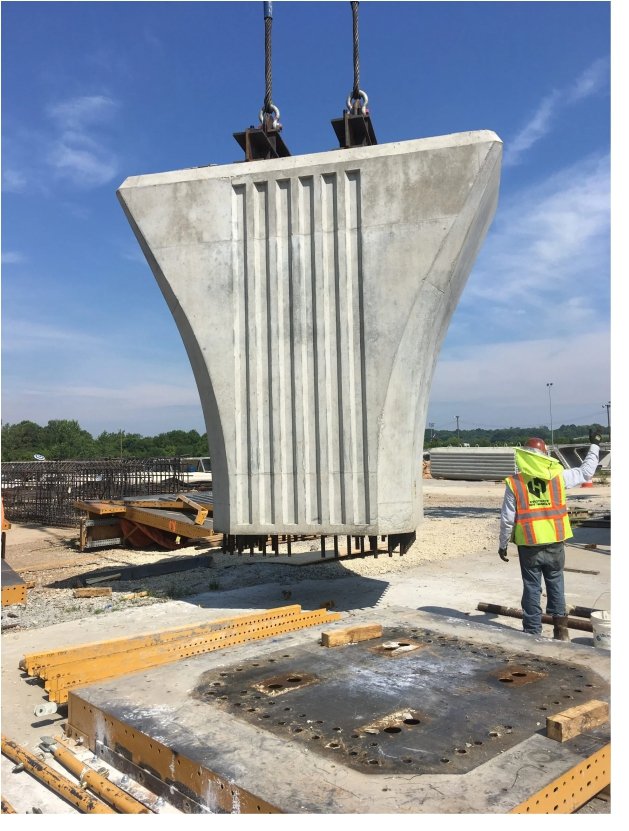 PRECAST
BRIDGE ABUTMENTS, BACKWALLS & WINGWALLS
PRECAST
BRIDGE ABUTMENTS, BACKWALLS & WINGWALLS
Bridge abutment and
backwall components support the loadings of the bridge superstructure, support
the bridge approaches, and retain the earth behind the beam ends. Wingwalls are
adjacent to the abutment and act as small retaining walls to further support
the embankment.
Typical on-site CIP
construction for these components is a slow process. To decrease on-site
construction time, the solution is to precast these items in an off-site plant.
The pieces can then be trucked to the site and quickly erected and fastened
using one, or a combination, of the innovative connection options available for
precast.
SUPERSTRUCTURE
SYSTEMS
These systems include both
the deck and primary supporting members integrated in a modular manner.
A precast deck is poured
integral with the supporting steel or concrete beams at an off-site, controlled
precast plant. This allows the bridge system to be transported to the site
already complete only requiring erection onto the substructure elements. These
substructure elements may be existing abutments/piers or newly fabricated
precast elements. The prefabricated system may also include the parapet or railing
such that additional on-site construction isn’t required and the bridge may be
operational sooner.
PRECAST
MOMENT SLABS & COPINGS
Pouring these components
on-site is a difficult task due to the complex forming and bracing required for
the portion of the coping that overhangs the retaining wall. They are also
labour intensive due to the heavy rebar cages required to withstand the
vehicular impacts on the barrier that the moment slabs support.
Precast is the solution to these job-site problems. A precast coping section with exposed rebar eliminates the need to form over the side of the retaining wall and gives the contractor a ledge to setup forms on for their barrier. Rebar extends both vertically and horizontally to tie the CIP barrier and pavement/moment slab together. A precast moment slab system complete with a barrier and coping is also an option which eliminates the on-site forming altogether and significantly decreases on-site labour required.

Related Articles




Current Issue

10-2026
